Dressmaker Decorations: Appliqué, Lace, Bows and Buttons
Decoration ideas for the Dressmaker game: where to place bows, appliqué, lace trims and buttons, how to match decorations to a customer, and when to stop.
Decoration is Dressmaker at its most generous: buttons, bows and appliqué, lace trims and accessories, and complete creative freedom over where they go. It is also the stage where a good dress becomes a memorable one — or a cluttered one. This guide gives you a working method for decorating with intent.
Decoration is the cheapest experiment in the game
Cloth costs coin, and a bad cut costs the whole panel. Decorations carry no such risk — they go on wherever you like, and the only cost of a bold choice is trying it. So develop your taste here, at the safest workstation in the shop. The dress underneath is already done; you are adding the argument that makes it special.
A simple method: one focal point, supporting details
Almost every well-decorated dress has a visual hierarchy:
- Choose one focal decoration. The thing the eye lands on first: a bow at the waist, an appliqué across the skirt, a dramatic lace collar.
- Add supporting details that lead toward it. Smaller buttons down a bodice, a trim running along an edge that points at the focal piece.
- Stop before it is too much. If everything is decorated, nothing stands out. Count your focal points: one is confident, two needs a good reason, three is a cry for help.
This is not a rule about quantity — it is a rule about attention. You are directing the customer's eye, and a dress can be richly decorated and still calm if every detail serves the same focal point.
Matching decorations to the customer and event
Once the sewing is done, the dress moves to the decoration stage — the game tells you "sewing complete" and invites you to add accessories before you finish the dress. Bows, lace trims, flowers and buttons each come in counted quantities, so place them with intent.
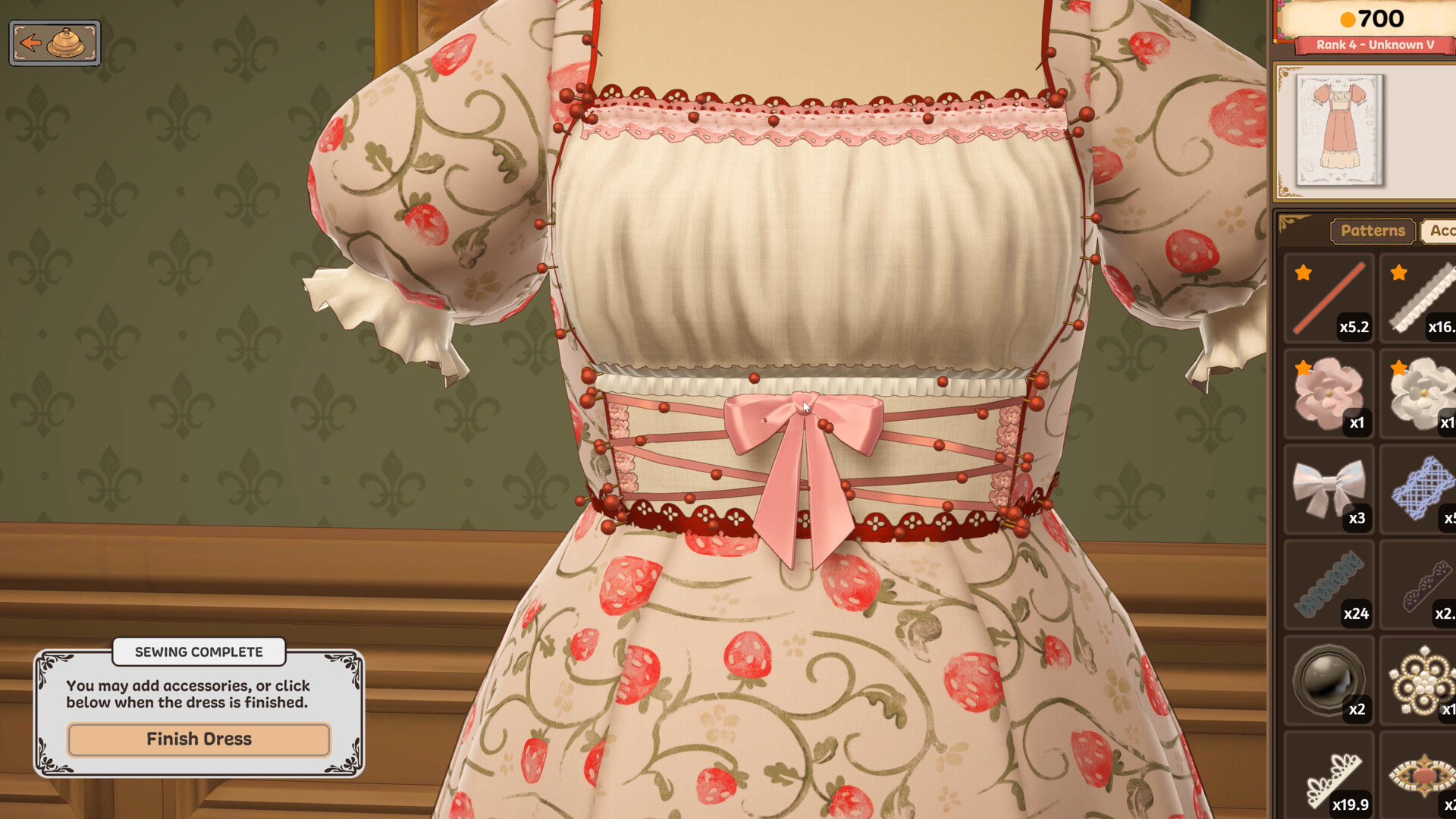
Decoration stage: "sewing complete" — ribbons, lace and a bow, with the accessory palette on the right.
The request tells you how loud to be:
- Formal events welcome drama: lace trims, silk bows, an appliqué with a story. Just keep the palette coherent so drama reads as elegance.
- Everyday dresses want restraint: buttons with character, a small bow, trim in a matching tone. Comfort first, sparkle sparingly.
- Playful customers are your license for colour: contrasting bows, appliqué shapes with personality, asymmetric placement that breaks the grid.
- Quiet customers ask for you to remove things, not add them. One perfect detail beats five nice ones.
The sketchbook is where you rehearse: attach appliqué and fabric samples before the dress exists, and compare two decoration plans side by side before committing.
Placement ideas that reliably work
When in doubt, these placements are hard to ruin:
- Waist bows define the silhouette and suit almost every shape of dress.
- Trim along hems and necklines frames the garment the way a mat frames a picture — it finishes edges without stealing attention.
- A single appliqué on the skirt's open space gives the eye a landing spot; place it where the fabric has room to show it.
- Button lines down the back or bodice add craft and rhythm, especially in a contrasting colour.
- Cuffs and collars in a second fabric count as decoration too — trim pieces in a different cloth make a simple dress feel custom.
Four decoration mistakes to avoid
- Decorating to fix a dress. If the silhouette is wrong, decoration cannot save it — fix the pattern layout instead (grain and bias are the usual culprits).
- Ignoring the fabric's voice. Velvet wants minimal, elegant punctuation; piling appliqué onto velvet is shouting over someone mid-story. Let the cloth set the volume.
- Symmetry by default. Perfectly mirrored decoration is safe and often lifeless. Try one asymmetric element and watch the dress wake up.
- Decorating everything you own. The shop window is where experimental pieces live; commissions reward reading the customer. Match the decoration budget to the purpose.
The habit that levels you up
After each delivery, look at the finished dress and ask one question: what would I remove? The answer trains your eye faster than any guide — and sooner or later, the answer becomes "nothing", which is how you know the dress is done.
Game screenshots: Dressmaker © Cozy Lives / Free Lives.