Dressmaker Pattern Guide: Grain, Bias and Smart Layouts
Why your Dressmaker dresses look different from the sketch: how pattern placement, grain lines and bias cuts change the final garment, and how to lay out fabric.
In Dressmaker, the sketch is a promise and the pattern layout is where you keep it. The game is explicit about this: whether your pattern is aligned to the grain or cut on the bias, how you arrange and cut out your fabric is what appears on the final dress. This guide explains grain and bias in game terms, then gives you a layout method that saves fabric and produces deliberate-looking dresses.
Grain and bias, in plain language
Real cloth behaves differently along and across its weave, and Dressmaker borrows that idea:
- Grain-aligned pieces follow the direction of the fabric. They are stable and predictable: the panel hangs as its shape suggests, stripes and textures run in an orderly direction, and the finished garment looks crisp.
- Bias-cut pieces are placed diagonally across the fabric. Cutting on the bias gives the panel a fluid, stretching drape — the fabric falls in soft curves instead of straight lines. It is the difference between a skirt that swishes and a skirt that stands.
The cutting table makes grain alignment a visible, scored mechanic: every pattern piece carries a grain arrow, and the game rates each piece's "Grain Quality" as you place it — at 100%, the panel hangs exactly as drawn.
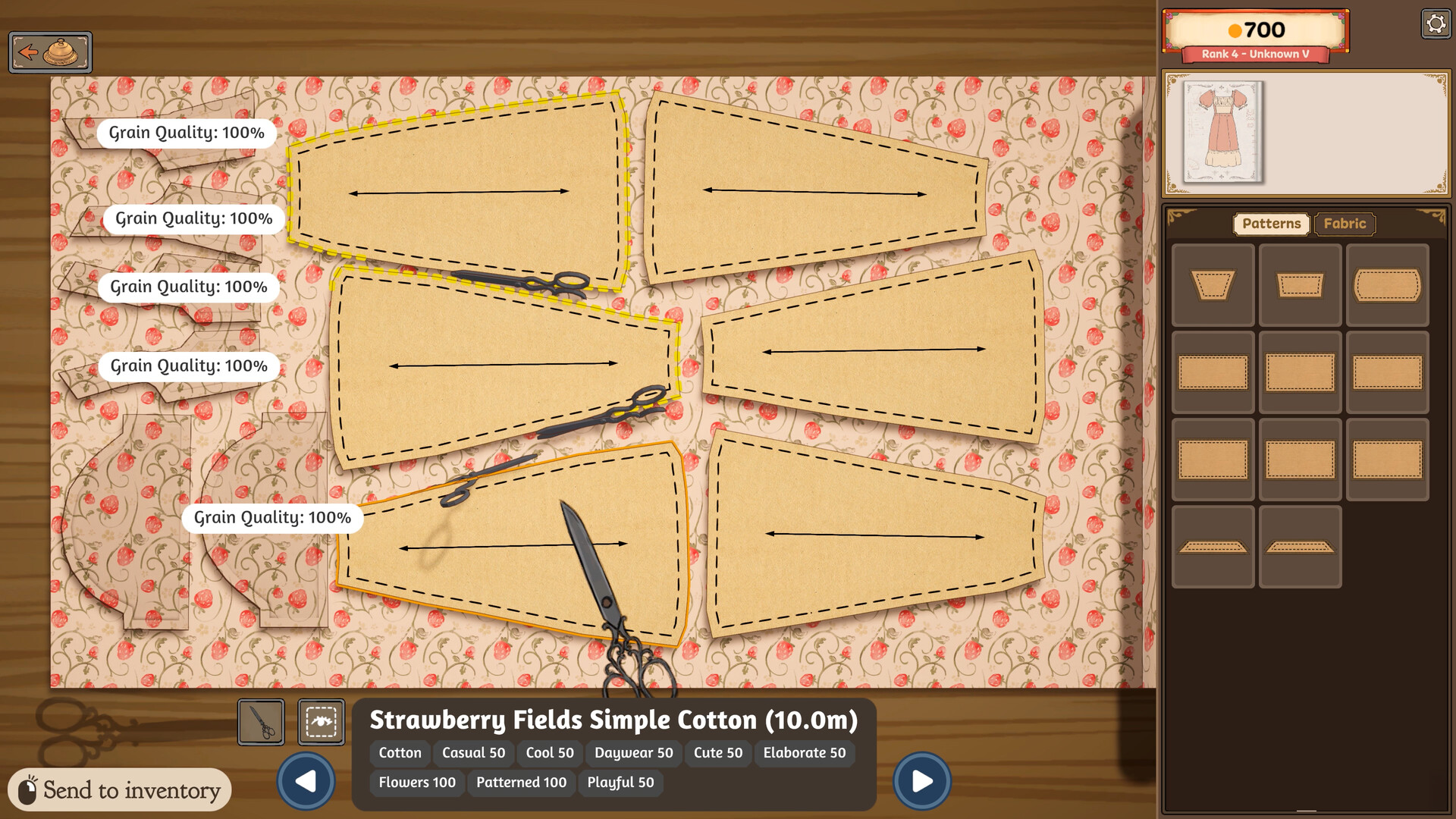
Every piece shows its grain arrow and a live "Grain Quality" rating — keep them all at 100% unless the design says otherwise.
Neither is "better". The question is always what the dress is supposed to do: a tailored bodice wants grain; a flowing skirt begs for bias.
Why placement changes the look of the dress
Because placement is rendered onto the final garment, two dresses cut from the identical pattern and fabric can look like different designs:
- Texture and pattern direction follow your placement. Align panels one way and the dress reads orderly; mix directions deliberately and it reads designed; mix them carelessly and it reads accidental.
- Drape follows placement. Bias panels flow and cling; grain panels hold their shape. A "flowing" customer request is a bias-cut request.
- Fabric consumption changes with layout. Tilted pieces waste cloth; packed pieces conserve it. Skill is getting the look you want for the least fabric.
A five-step layout method
Use the same ritual every time and layouts stop being stressful:
- Sort the panels by role. Structural pieces (bodice, waistband) want grain. Pieces that should flow (long skirts, drapes, sashes) are bias candidates.
- Place the large pieces first. Big panels lock in the layout's look and eat most of the fabric; fit small pieces around them afterwards.
- Keep directions consistent by default. Unless a mixed direction is a deliberate design choice, run all grain pieces the same way. Consistency photographs well.
- Pack tightly, cut margins honestly. Slide pieces close together to save fabric — but never overlap a cutting line. Wasted cloth is cheap next to a ruined panel.
- Preview on the mannequin before cutting. This is the single most valuable habit in the game. The mannequin shows how placement will read on the finished dress, and it is the only place a layout mistake costs nothing.
Matching layout to the customer
Layout is a language customers understand even if they never mention it:
- Event is formal → grain-aligned structure for the bodice, and if the skirt should sweep, bias.
- Customer wants comfort and movement → bias-heavy layout with soft drape.
- Customer wants polish and presence → grain-heavy layout with clean lines.
- Taste is bold and individual → this is where a deliberate contrast — a bias panel against a grain panel — earns reputation.
Common layout mistakes (and their tells)
- Everything on the bias. The dress drapes beautifully and fits like a sack. Tell: the customer asked for a "proper" dress and got a mushy one.
- Everything on the grain, always. Safe, stiff, forgettable. Tell: your dresses stop winning "flowing" requests.
- Random directions. The dress looks busy with no idea behind it. Tell: screenshots where panels obviously disagree.
- Layout by panic. Dragging pieces to fit the remaining fabric after two bad decisions. Tell: you, muttering at the cutting table. Restart the layout instead — it is cheaper than the dress.
The payoff
Master layout and everything downstream gets easier: cutting has a plan, the sewing machine receives well-cut pieces, and decoration lands on a dress that already reads as intentional. Grain for structure, bias for flow, mannequin before scissors — that is the whole discipline in one sentence.
Game screenshots: Dressmaker © Cozy Lives / Free Lives.